
Maintenance
Why Your Toyota Overheats in Abuja Traffic: A 10-Point Cooling Checklist
Arlington Parts Desk · 2026-02-27 · 7 min read
Overheating that happens in stationary traffic but settles at speed almost always points to a fan, fan clutch, radiator cap or thermostat fault rather than a blocked radiator. Check the coolant level and cap first, then the fan operation, then the thermostat, then pressure-test the system. A worn radiator cap alone is a common cause because it lets the system run at low pressure.
Read the symptom properly
When the temperature rises tells you which part to suspect.
- Rises in traffic, settles at speed: fan, fan clutch or shroud problem.
- Rises at speed, settles in traffic: blocked radiator core, failing water pump or a restriction.
- Rises quickly from cold within minutes: thermostat stuck closed, or low coolant.
- Fluctuates with the heater on: air in the system after a coolant change.
- Rises only with the AC on: condenser airflow or fan issue.
The ten-point checklist
- Coolant level and condition — is it the correct pink SLLC at 50/50, or has it been topped up with water?
- Radiator cap — pressure-test or simply replace. A tired cap lowers boiling point and is the cheapest fix on this list (16401-0C010).
- Fan clutch on Hilux, Hiace and older diesel models — spin it cold and check resistance; a drained viscous coupling pulls no air at idle.
- Electric fan operation on later models — watch it start when the engine reaches temperature with the AC on.
- Fan shroud intact and fitted — a missing shroud drops airflow through the core dramatically.
- Radiator core condition — dust, insects and fin corrosion block airflow on the outside. Clean or replace.
- Thermostat — remove and test in hot water, or replace with housing (90916-03097).
- Water pump — check for play, weep-hole staining or a squeal from the bearing (16100-09201).
- Hoses — look for soft spots and bulges when hot; the upper and lower hoses are the usual leak points.
- Head gasket test — bubbles in the coolant, coolant loss with no visible leak, or milky oil means the failure has already moved beyond the cooling system.
What it costs to skip this
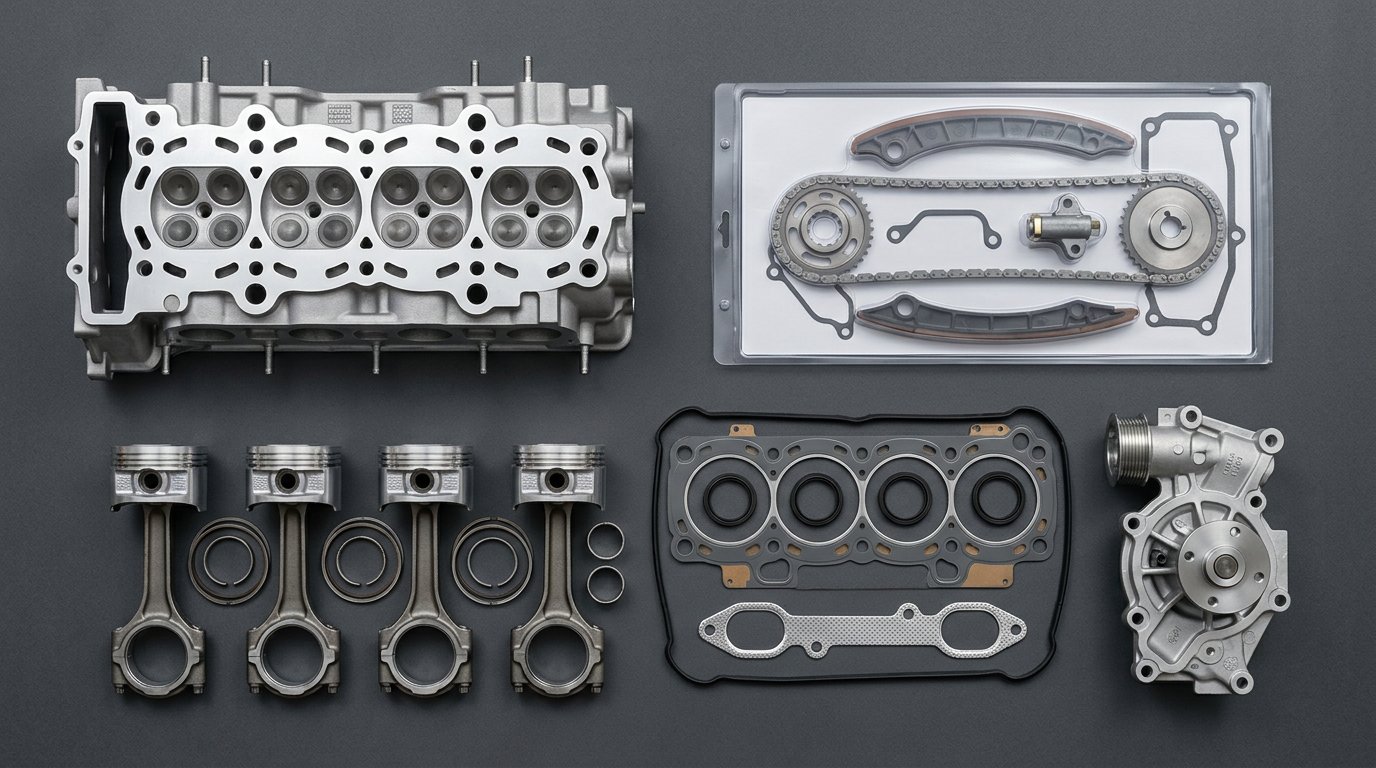
An aluminium Toyota head does not survive a serious overheat. Warping, head gasket failure and cracked heads are all outcomes of continuing to drive with a gauge climbing, and they move the repair from a few tens of thousands of Naira in cooling parts to an engine-out job. If the gauge moves, stop and let it cool rather than pushing to the destination.
Parts we keep on the shelf for this
Radiator assemblies for Hilux and Corolla platforms, water pumps, thermostats with housings, viscous fan assemblies, pressure caps, moulded upper and lower hoses, and the correct pink SLLC coolant ready mixed. If the part is not held at your nearest location we transfer it, usually within a day.
FAQs
Why does my car overheat in traffic but not on the highway?
In traffic there is no ram airflow through the radiator, so the fan has to do all the work. If the fan or its clutch is weak, the temperature climbs at a standstill and drops once you are moving again.
Can a radiator cap cause overheating?
Yes. The cap holds system pressure, which raises the boiling point of the coolant. A weak cap lets the system boil early, coolant escapes, and the temperature rises. It is the cheapest part to replace first.
Can I drive with the temperature gauge climbing?
No. Stop, let it cool and check the coolant level before continuing. Continuing to drive overheats the aluminium head and turns a cooling repair into an engine repair.
Which coolant should I use in a Toyota in Nigeria?
Toyota Super Long Life Coolant, the pink pre-mixed 50/50 product (08889-80082). Do not mix coolant types or top up repeatedly with water, as this reduces the corrosion protection the system depends on.